AI Marketing
Win Back Campaign: How to Bring Old Customers Back
How to run a win back campaign for a small business: list, message, sending and measurement, the US and Spanish email rules, and a real 900-email example.
 Christian Monge5 min read
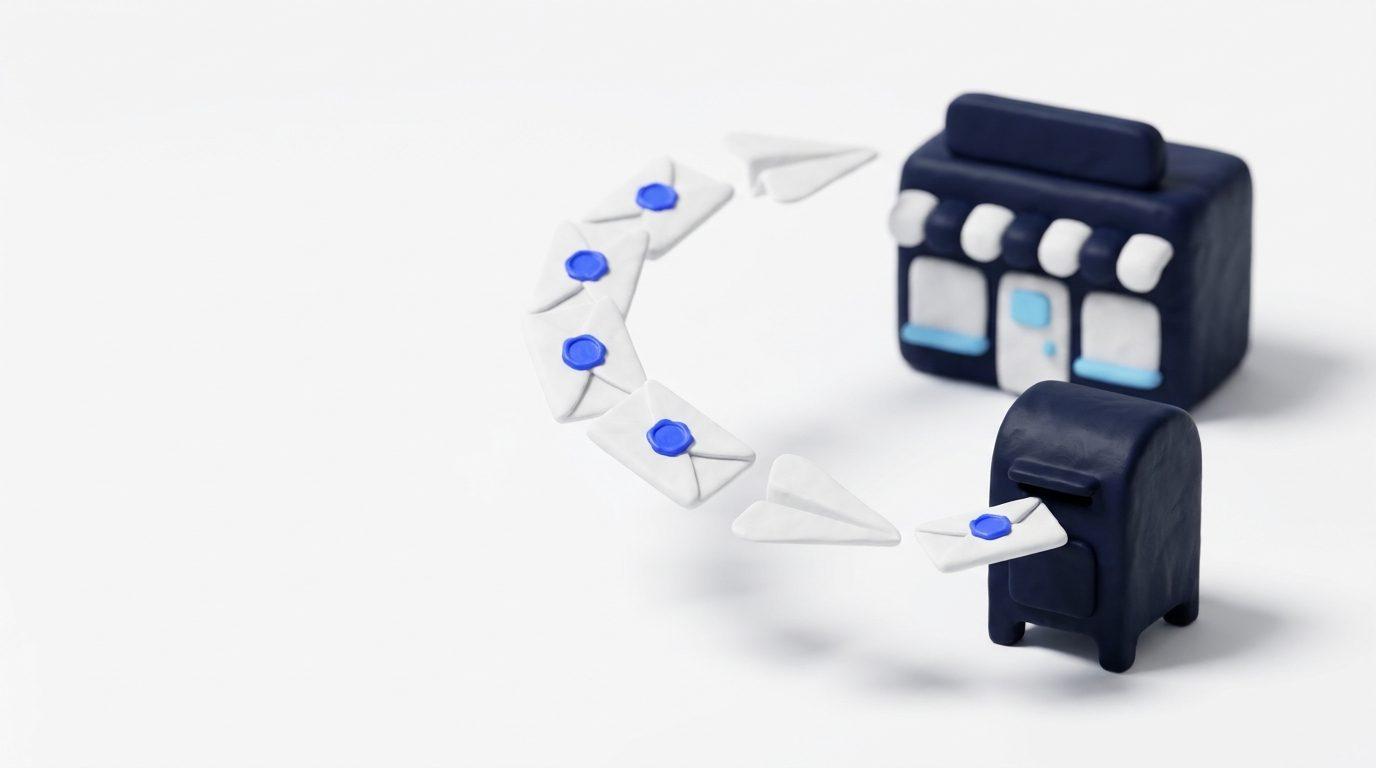
A win back campaign is a message, usually an email, sent to people who bought from you a while ago and stopped, with one concrete reason to come back.
For a small business it takes a few weeks to run and needs only your list, a good message and the email rules followed.
"Win back campaign" gets 170 searches a month in the United States (Pengu Insights, 18 Nov 2026). It is the service I recommend most to small businesses, because it works with something you already own and rarely use: your list of past customers. Here is how to run one yourself, step by step, with the legal basics and a real example.
What a win back campaign is, and when to run one
A win back campaign aims to get an inactive customer buying again. It is not a monthly newsletter or a mass discount. It is a message written for someone who already knows you and has not been around for a while.
It makes sense when two things are true. First, you have a group of customers who have gone quiet for longer than is normal in your business. Second, you have a real reason to write: a new product, an updated catalog, a checkup that is due or a season that is starting.
Without a reason, the email is just "we miss you," and nobody replies to that.
A real example: 900 emails, about 30 interested companies
Here is a campaign I ran myself. For a 20-person company in Nicaragua, I sent 900 emails to old contacts. About 30 companies replied asking for catalogs, roughly 3 %, according to my own campaign records.
No ads, no expensive tools. Just a list nobody was using, an email with a concrete reason and someone replying fast to everyone who answered.
Can you email past customers? The rules
In the US, yes, as long as every email follows the CAN-SPAM Act. In Spain, the rules are stricter and only cover genuine past customers.
United States. The FTC's CAN-SPAM compliance guide lists the requirements:
- No false or misleading header information. From, To and Reply-To must identify you accurately.
- No deceptive subject lines.
- Identify the message as an ad.
- Include your valid physical postal address.
- Tell recipients how to opt out, and honor opt-outs within 10 business days.
- Monitor anyone sending on your behalf. Hiring a sender does not move your legal responsibility.
The FTC notes that the law makes no exception for business-to-business email.
Spain. If your customers are in Spain, article 21 of the LSSI bans marketing email that was not requested or expressly authorized, with one exception. You may email without prior consent when there was a previous contract, you obtained the contact details lawfully, you write about similar products or services of your own company and you offer a simple, free way to opt out when collecting the data and in every message. Article 20 adds that the email must be clearly identifiable as commercial and show who is sending it.
Leads who never bought, trade-show cards and purchased lists fall outside that exception. For the full picture, read email marketing laws in Spain.
How to run a win back campaign step by step
There are eight steps. The slowest one is not writing: it is the list.
- Gather the list (1 to 2 days). Pull contacts from invoices, email, your booking system and old spreadsheets. Note what each person bought and when.
- Clean and segment (half a day). Remove duplicates and dead addresses. Take out anyone who unsubscribed in the past. Split by what they bought, because the reason to return changes.
- Check the legal basis (1 hour). Mark who was a real customer and confirm the opt-out you will use.
- Pick the reason to come back (1 hour). Something concrete and current: a new catalog, a new service, a checkup, a season.
- Write the email (2 hours). Short, signed with your name, one ask and a visible opt-out.
- Prepare the send (half a day). Make sure your domain is authenticated, as explained below.
- Send in batches and reply fast (1 to 2 weeks). Answer anyone who replies the same day. That is where the campaign is won or lost.
- Measure (1 hour). Replies, interested contacts and sales. Log every reply with its outcome.
For step 6: Gmail requires every sender to authenticate with SPF or DKIM and keep the spam rate below 0.3 %, according to its sender guidelines. If you send 5,000 or more messages a day to Gmail accounts, you also need DMARC and one-click unsubscribe.
For step 8: add UTM parameters to the links in your email. Google Analytics says to always use utm_source, utm_medium and utm_campaign, for example utm_campaign=winback-2026.
A win back email template
A good win back email is short, personal and asks for one thing. Treat this as a starting point and rewrite it in your own voice.
Subject: New fall catalog, Anna
Hi Anna,
It's Luke from Example Shelving. You bought warehouse shelving from us a while back, and I wanted to let you know we have a new catalog with taller models.
If you'd like it, just reply to this email and I'll send it today.
Best, Luke
Example Shelving, [your postal address]. You are receiving this because you were a customer. To stop these emails, [unsubscribe here].
It says who is writing, offers something similar to what they bought, carries your postal address and includes the opt-out. Replace the bracketed text with your real address and unsubscribe link before sending, and make sure it is clear the message is promotional.
Mistakes that sink a win back campaign
- Emailing a list that is not yours. In Spain, a purchased list falls outside the LSSI exception, and anywhere it reaches people who never asked to hear from you.
- No reason to write. "It's been a while" is not a reason to reply.
- Blasting everything at once from an unauthenticated domain. You land in spam.
- Replying slowly. Someone who answers today and hears back in a week has moved on.
- Not logging results. Without data, the next campaign starts from zero.
A win back campaign fits inside a broader set of customer retention strategies.
It is also a strong first move in a 90-day marketing plan for a small business.
How I run it for €490
If you would rather not do it yourself, the reactivation campaign is my flagship service at a fixed €490 per campaign. I recover and organize your old contacts, write the email in your voice, you approve it, I send it and I hand you the list of who replied. All my services are on my home page.
And if you also want to know why new customers are not finding you on Google, my SEO + AI audit is €390 plus VAT, one-off, with a 90-day plan. They are separate services, so start with whichever is more urgent.
Frequently asked questions
What is a win back campaign?
A message, usually by email, sent to people who bought from you in the past and stopped, with a concrete reason to come back: a new product, a checkup, a season or an updated catalog.
Is it legal to email past customers?
In the US, yes, if each email follows CAN-SPAM: accurate headers, a truthful subject line, identification as an ad, your postal address and a working opt-out. In Spain, the LSSI allows it without prior consent only for past customers, about similar products of your own, with an easy, free opt-out in every message.
What response rate should I expect from a win back email?
There is no number that fits everyone. It depends on how old the list is, the industry and the offer. As one real data point, a campaign I ran with 900 emails to old contacts brought about 30 interested companies, roughly 3 percent.
How often should I run a win back campaign?
When you have a group of customers who have gone quiet for longer than normal in your business, and a real reason to write. For many small businesses, reviewing the list once or twice a year is enough.
How much does a win back campaign cost?
Done yourself, mostly hours: building the list, writing the email and replying. If you hire me, my reactivation campaign is a fixed €490 per campaign: I recover and organize your contacts, write the email, you approve it and I send you who replied.
Sources

Christian Monge
Teaches AI workshops at EAE Business School, builds AI second brains with Obsidian and Claude Code, co-founded the competitive-intelligence SaaS Pengu Insights and publishes his Claude skills for free. Trains teams in English and Spanish from Madrid.
More about meSEO + AI audit
Want to know what your website is missing?
I review your site, your Google Business Profile and whether ChatGPT recommends you. Start with a free 90-second video, or go straight to the €390 audit.
See the SEO + AI auditKeep reading
AI Marketing
AI for Accountants: Practical Uses and Honest Limits
AI for accountants and small firms: six practical uses, which client data never goes into a chat window, and the data protection rules that still apply.

AI Marketing
AI for Restaurants: Practical Uses and Honest Limits
AI for restaurants without the hype: menu descriptions, review replies, booking follow-ups, social posts and demand planning, plus the limits you should keep.

AI Marketing
AI Tools for Social Media: Create, Schedule, Measure
AI tools for social media for small businesses: what to use to create posts, schedule them and track competitors, with checked prices and a verdict for each.